One Movement Break for a Desk-Bound Afternoon
A movement break for a desk-bound afternoon helps you change position comfortably, loosen up and return to work without turning the pause into a workout.
The common mistake with a movement break for a desk-bound afternoon is waiting until you feel stiff, restless or thoroughly fed up before getting up. By then, a small pause can feel like another task to squeeze in. Instead, choose one ordinary point in the afternoon and use it to change position or pace gently.
This is not a workout plan or a promise that every pause will feel refreshing. It is a low-pressure routine for an afternoon when work keeps you near a desk. You can walk to the kitchen, stand by a window or shift to a different kind of task. The useful change is often modest: your body is no longer held in quite the same position, and your attention gets a brief change of scene.
Choose the pause
Pick a moment that already has a natural boundary. It might be after you send a piece of work, before you begin a call, when you finish a drink, or when you notice you have been sitting through several tasks. A practical cue is not a strict schedule; it is a point at which you can pause without leaving someone waiting or abandoning something urgent.
Make the break small enough to fit a normal afternoon. You do not need special clothing, a mat or a set of exercises. The choice can be as simple as standing, taking a few comfortable steps, or doing a familiar household action while upright. If standing or walking is uncomfortable, choose a supported change of position that suits you instead.
Think of it like turning a page rather than starting a new chapter. The pause marks a gentle transition, not a demand to overhaul the rest of your day.
Read the afternoon
Before you move, notice what is happening without trying to diagnose it. Are you sitting in one position because you are concentrating? Has the last task left you mentally crowded? Do you have room to step away, or is a call about to begin? These observations help you choose a break that fits the actual moment rather than an idealised routine.
Keep the choice plain. If you feel comfortable standing, stand and let your posture settle. If you want a little movement, walk at an easy pace to refill a glass or look out of a window. If you would rather stay near your desk, shift your weight, reposition your feet or sit back in a different comfortable way. There is no need to stretch to an end point or turn a passing feeling into a performance target.
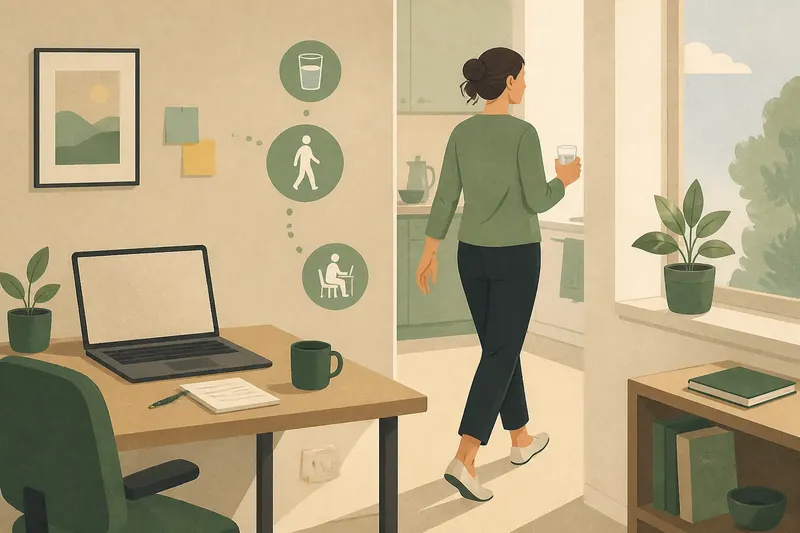
Say you have been working at a laptop and notice that you are leaning towards the screen, while a document is still open and your next call is several minutes away. You might save the document, stand, walk to the kitchen for water and return by a different route. The expected observable result is simply a change from sitting at the laptop to walking and then sitting again; you can decide afterwards whether that suited you.
Use one pause
Try the routine over a working week, but treat each day as a fresh decision rather than a streak to maintain. Choose one suitable pause during the afternoon. On a day with fewer interruptions, it may fit after a completed task. On a busy day, it may be a brief position change between calls, provided that does not make you late or distracted.
- Notice a boundary. Look for a task ending, a natural lull or a moment when you realise you have stayed in one position for a while.
- Check what is practical. Consider your comfort, space, access needs and immediate responsibilities before choosing how to move.
- Make one change. Stand, take a short comfortable walk, or adjust your position without adding a target for distance, pace or repetitions.
- Return deliberately. Resume the next task when you are ready, or continue with a different suitable activity if you have more time.
- Keep the decision open. If the chosen movement does not suit that moment, stop and choose a gentler alternative or leave the pause for later.
The point is not to complete every item like a scorecard. The sequence gives you a simple way to make a decision when the afternoon is full of small demands.
Adjust for real days
A desk-bound afternoon rarely repeats itself exactly. Some days you can walk down a corridor or outside; on others, your work, energy or surroundings may make that impractical. Keep the principle and change the form. A slower walk, a supported standing pause or a comfortable seated adjustment can all serve as a change from holding one position.
If you work from home, a trip to the sink or a short walk between rooms may be convenient. In an office, you could stand to read a printed note or walk to a shared space if that fits your duties. If you cannot leave your station, you might turn away from the screen briefly and settle into a different comfortable position. These are options, not a ladder where one version counts more than another.
Comfort matters more than completing a prescribed movement. Keep the action within what feels manageable, and stop if it causes pain, dizziness or unusual discomfort. If you have a health condition, mobility concern or persistent symptoms that affect movement, ask a qualified health professional for advice suited to you.
Questions about movement breaks?
How long should a movement break last?
There is no single duration that suits every desk or afternoon. Let the pause fit the opportunity: a position change can be brief, while a walk can last longer if your responsibilities and comfort allow.
What if I cannot leave my desk?
Choose a comfortable change you can make where you are, such as shifting how you sit or standing beside the desk if that is suitable. If movement is not practical at that moment, wait for a more workable pause rather than forcing it.
Should I stretch during the break?
Stretching is optional, not a requirement. If you already know a gentle stretch that feels comfortable, you may choose it, but an easy change of position or pace is enough for this routine.
What if I forget the pause?
Use the next natural boundary you notice rather than trying to make up for a missed one. The routine is meant to help you make a manageable choice, not create another obligation.
Keep it low pressure
At the end of the afternoon, you can note which pause felt easiest to fit: after finishing a task, between calls, or when you went to get water. There is no need to record every break or judge whether it was effective. A useful observation might be that leaving the desk was awkward on call-heavy days, while a seated adjustment was easy to make.
For a movement break for a desk-bound afternoon, the most useful plan is one you can adapt without turning it into a test. Choose a suitable moment, make an ordinary change of position or pace, and let comfort guide what comes next. If the afternoon closes before a pause fits, leave it there; you can make a fresh choice the next time a natural opening appears.